
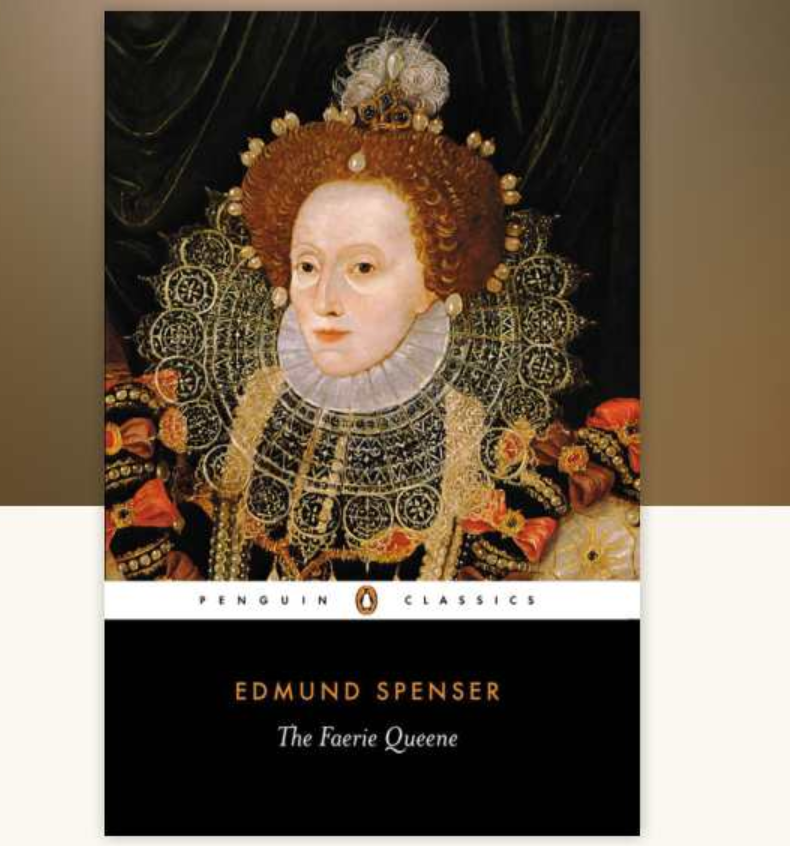
Edmund Spenser’s “The Faerie Queene” can be smoothly described as one of the best works of the late fifteen hundreds. The use of allegory and religion are ever present throughout the text, and can be identified in a number of characters. The character of Una plays a particularly interesting role in book one. Not only does she bring light and true love to the story but she may well have been the true heroine of “The Faerie Queene.”
The character of Una is one of great importance in Spenser’s first book. Being one of the lead females in the poem and quite arguably the heroine of book one. The allegory and purity of this character is identified within the first number of cantos. From Spenser’s first description of the character of Una, a sense of beauty and gracefulness surrounds us. “So pure and innocent, as that same lambe,/ She was in life and every virtuous lore”. (Fq, 5. i. 1) From this quote, it can be determined that Una is beautiful and virtuous. Una represents total purity in the poem, she is kind, virtuous and beautiful, which is a fair representation of what the perfect woman could be in Spenser’s time. Her beauty is constantly mentioned throughout the poem, even in the very final canto. “The fairest Una, onely daughter deare,/ His onely daughter, and his only heir.” (Fq, 21. xii. 1) From the way Spenser spells “onely”, it can be said that he is trying to assert her uniqueness and personal unity. Una’s name alone is of great significance as it can be defined to mean “oneness”. From this, it can be said that her name perfectly encapsulates the qualities that Una portrays throughout the poem. Despite this character having many plausible traits, the two which Spenser ensured would be noticed are that Una exhibits the unity of truth and also the one true church. This means that Una has always been sure of herself, who she is, what she must do and what her beliefs are. This can be hugely contrasted to Redcrosse, which is unsure decision-making and carelessness. Una is certain of the majority of things she does, she’s sure of her morals and her love for Redcrosse and her family, as well as making sure to make time for her christianity. Furthermore, Una’ character also illustrates the importance of having harmony within yourself and not to allow yourself to indulge easily in your deepest desires and to show a brave front when facing your fears. Which contrasts yet again with Redcrosse’s character who continuously changes his mind about himself and others. Additionally, this can also be compared to the Una which is conjured by Archimago in order to deceive Redcrosse. The fact that at the time Redcrosse believed that the seductive Una, who was willing to break her virtue, was the real Una, signifies just how unwell he knew her at the time, as everything the conjured Una did goes against everything the real Una stands for. This may be yet another possible reason for why Spenser named her “Una”, because unlike other characters she never doubts herself, she stays throughout the story the Una we know and love, she is one with herself.
As previously stated, it can be said that Spenser meant for Una to have some representation of the One True Church, meaning the Protestant Church. As already identified, Una is very dedicated to the christian within her. The moment in which she is first introduced to the story, she is seen riding a donkey, which was the animal which Jesus used to enter Jerusalem. Spenser may have used a donkey here instead of a horse, in order to suggest that like Jesus, Una is a gentle and humble character. Protestants were recognised for their modesty and humbleness as well simplicity. Throughout the poem, not much is revealed about what Una is wearing, but it is mostly said to be plain black clothes, with no colours or embroideries of any sort. At the very end of book one, however, she is wearing all white. “And on her now a garment she did weare,/ All lilly white, withoutten spot, or pride,” (Fq, 22. xii. 1) This further proves the embodiment of christianity in Una. Spenser also mentions that Una has a lamb as her companion. This lamb could potentially symbolize Jesus; lambs can be seen as innocent creatures but they are also used to be sacrificed to God, just as Jesus did. Furthermore, this lamb could also be yet another metaphor for Una’s virginity. The innocence of the lamb provides a sense of this as having your virtue was considered to be of great significance for a woman in Spenser’s time. This can be compared to the evil witch, Duessa, who formidablely goes against everything Una’s character symbolizes. Whilst Una dresses in white, Duessa dresses in red. Duessa is lustful and deceitful, which in Spenser’s time is no way for a woman to be. This therefore sheds yet more truth in the allegories of the character of Una.
Redcrosse, being the main character and the brave knight, is by majority seen as the hero of the text. However, there is evidence to suggest that Una is in fact the true heroine of the story. By analysing each Canto and reading carefully through the events that take place, it is hard to ignore that without Una, Redcrosse would not have made it very far and may never have completed his quest. Numerous times throughout the story, it is Una that saves Redcrosse. Her bravery shines through on many occasions. Una is Redcrosse’s voice of reason. In Canto I, at the beginning of the quest when the rain begins to fall, Redcrosse wants to find refuge in a cave they stumble upon. Una warns him that they should not go in and to be cautious, but Redcrosse does not listen, and after they face the monster Error, who is half snake, half woman. Redcrosse, luckily, manages to defeat Error, but it’s not long after this that the group meet the troublesome Archimago and he conjures up the lustful fake Una and more trouble comes Redcrosse’s way and he abandons the real Una without knowing. Most women at this point probably would have been frightened, being left alone, but Una is not like most women, she pulls herself together and sets off to find Redcrosse. On her journey alone in the forest, she encounters a lion, who upon first glance tries to attack her, but after noticing her beauty he becomes her companion instead. Spenser is highlighting yet again, how truly beautiful she is, that even a wild lion would not harm someone so beautiful. “His bloudie rage asswaged with remorse,/ And with the sight amazed, forgot his furious forse.// In stead thereof he kist her wearie feet,/ And lickt her lilly hands with fawning tong,” (Fq, 5-6. iii. 1) To further demonstrate the extent of Una’s heroism, it is important to note the incident with Orgoglio. Despite this entire time, being left alone, and then being captured by the evil Archimago, she persevered and found help from a brave knight named Arthur, who helped her rescue Redcrosse from the giant. At this point Redcrosse had been imprisoned at the giant’s lair for quite some time. He had become skinny, weak and would surely have died if it were not for Una, as no one else would have come to rescue him. This can also be compared to the incident with Despair.
From this analysis of the character of Una, it is evident that the allegory of this character is present throughout. Una is pure and virtuous until the very end.
Bibliography:
- Spenser, Edmund, A. C. Hamilton, Hiroshi Yamashita, and Toshiyuki Suzuki. The Faerie Queene. Oxon, England: Routledge , 2013. Print.
Presentation: The Contrast of Light and Darkness in Female Characters in Spenser’s “The Faerie Queene”
- As we have probably already established, the characters of Duessa and Una are worlds apart. Being the two lead females in book one it is hard not to notice just how much they are the opposite of one another.
- Una represents total purity. She is virtuous, fair and kind. Not only this but Una’s name actually means “One”, this is because of the qualities Una’s character captures; the unity of truth and the one true church. Spenser’s description of Una fills us with a sense of gracefulness and peace and we receive this perception of her even in the very beginning of Book 1 when Spenser writes that she is …“So pure and innocent, as that same lambe,/ She was in life and every virtuous lore”.
- Una’s character expresses the importance of having harmony and unity within yourself, and to not let yourself be consumed by your fears and desires. She is the definition of a pure soul.
- Unlike Redcrosse, who is constantly doubting himself at every turn, Una is always sure of herself and sure of her love for Redcrosse. Una is also extremely brave, we are constantly presented with demonstrations of her bravery throughout Book 1. She has saved Redcrosse more than once and it would be safe to say that without her, Redcrosse would have never completed his quest. She displays this bravery on many occasions, such as the incident with the Giant, Orgoglio when she rescues Redcrosse and is reunited with him after searching for him for some time and also the incident with Despair. Una is the light not only in Redcrosse’s life but she is also a representation of light in Book 1.
- Duessa on the other hand is the explicit opposite of Una. Her introduction into the poem instantly shows us that she is lustful, cunning, deceptive and overall down right evil. From her introduction in the poem we are instantly filled with a sense of darkness and sin in relation to Duessa’s character. She is never what she appears to be, just like Archimago. Just from her name she is instantly contrasted with Una, Una as we know means “One” but Duessa’s name implies she is two things, due to her deception skills and her physical appearance.
- Due to her incredible skills of disguise and deception she made Redcrosse engage in sinful acts, which Una would have never done. In canto 2, Duessa disguises herself as Fidessa which means faith. However Duessa is very much opposed to the idea of faith, which completely contradicts Una’s beliefs and, in fact, everything Una’s character stands for. Spenser could be hinting towards the contrast between Catholic and Protestant.
- From the two descriptions of these female characters, the clash of characters is evident. Una’s character is dressed in white and Duessa is dressed in red. Una represents everything that is pure and kind, and Duessa represents nothing but falseness and evil. Una is virtuous and devotes her faith to Christianity whereas Duessa has dealings with Demons and even knows how to enter hell. They are undoubtedly the contrast between good vs. evil, light vs. dark.
Poem written in the format which is used in “The Faerie Queene”
There comes a time in our lives,
Where we must choose our road.
As the hour quickly arrives,
You could say that I flowed.
And as i looked upon sky blue eyes,
Feeling the spark from a simple touch,
It was as if I could fly,
And nothing has ever meant as much,
As seeing the starry black sky.
Analysis of Canto V
In Canto v of Spenser’s “The Faerie Queene” quickly picks up where Canto iv left off as we eagerly await the battle between Redcrosse and Sansjoy. As the characters enter, the knights look equally as fierce as each other. As the ladies, Lucifera and Duessa enter and take their seats, the battle begins. The knights fight bravely and with strength, they are evenly matched and do quite some damage to one another. As they fight, Sansjoy notices that Redcrosse possesses his brother’s shield and in his anger he knocks out Redcrosse. Our brave knight begins to lose hope and just as it seems that Sansjoy has won, the evil Duessa begins to encourage Redcrosse, which is unexpected. Duessa’s encouraging words allow Redcrosse to regain his strength and fight back. With his newly recovered stamina he gains the upper hand and defeats Sansjoy. As we are about to witness the anxiously awaited death of Sansjoy he evaporates into a black cloud of sorts and disappears. As readers this is baffling and even more so for Redcrosse. Duessa quickly steps in, congratulating Redcrosse on his victory, but the knight is confused and suspicious by the turn of events and questions whether his victory is indeed real.
As Redcrosse gets his wounds attended to, Duessa sneaks off in her sorrow to visit the Night. Duessa explains to the Night of how her nephews (Sansfoy, Sansjoy, Sansloy) are either dead or dying and pleads for the Night to save them. The Night agrees but not before questioning why Duessa concerns herself with them and Duessa reveals her true character to the Night. After a small reunion the two head off in order to rescue Sansjoy and bring him to the Underworld where they plan to hide him and treat his wounds. On their journey we are presented with images of various supernatural beings, such as the guardian dog Cerberus and the dead being tortured. Duessa and the Night take Sansjoy into a dark shadowy cave in the depths of the Underworld. Here they seek the help of Aesculapius who is the God of medicine. Aesculapius was banished to the Underworld in order to atone for the crimes he committed against Hippolytus. Hippolytus had once been dead but thanks to Aesculapius’ magic he was revived. Jupiter, however, was not content with Aesculapius’ actions to resurrect Hippolytus as he could not just go around resurrecting everyone who is dead, otherwise death would not have meaning. Because of this Aesculapius was banished. Now that the two ladies have come seeking his help, he is hesitant as he does not want to be further punished by Jupiter, but he is easily swayed.
When Duessa returns to Lucifera’s palace, she discovers that despite not yet being fully healed, Redcrosse had left. Upon the Dwarf’s discovery of the captives Redcrosse ran to their rescue. He snuck off at dawn to avoid being sighted and as he left he was not filled with joy or excitement for his next task, instead he was full of sorrow as we walked by the many dead bodies that lay scattered around the palace.
Pride in Spenser’s “The Faerie Queene”
Pride is something that we all feel at some point or another in our lives. It’s part of being human. The essence of pride in Spenser’s “The Faerie Queene” is ever so present throughout book 1. We mainly see pride in Redcrosse. From the moment we first meet Redcrosse we know he is a valiant and handsome knight. Despite having never actually been in any battles Redcrosse wears his armour proudly and has faith in his capabilities. As Redcrosse and his companions take on the monsters and villains that cross their path, Redcrosse’s pride grows stronger. However, the duration of this pride in Redcrosse does not last too long, and throughout book 1 his pride varies quite a lot. His pride deteriorates when he meets the evil but beautiful Duessa. Redcrosse’s loyalty to Una is jeopardised and he is ashamed of his actions.
Duessa takes Redcrosse to The House of Pride during their time together. The House of Pride is ruled by Queen Lucifera and it is described as a magnificent and beautiful palace. Living with the Queen Lucifera are her subjects who just so happened to be named after the seven deadly sins. This is interesting because having pride could probably lead you down the path of one of those sins so it is probably not an accident that Spenser called it The House of Pride. In the duration of time that Redcrosse spends there he fights the fierce Sansjoy and wins, which sure boosts the tremendous pride he may already have. The Queen Lucifera herself is quite proud and thinks herself above Redcrosse and Duessa. It is also important to note the dead bodies mentioned lying at the gates of The House of Pride. These could be the victims of pride that have fallen. Redcrosse should have been more concerned about entering and staying at this palace. Yet shortly after he leaves the palace he is put under a spell when he accidentally drinks some enchanted water that turns you lazy, weak and cowardly. Which is an underlying contrast to how we viewed him at this point, because he is meant to be a fierce knight and he is now stripped naked and does not seem concerned with his quest any longer.
Himself and Duessa then run into quite a bit of trouble when the Giant, Orgoglio, captures them. When Redcrosse is found after some time of being imprisoned in Orgoglio’s castle, he is weak, skinny and scared. His pride surely has taken some damage after this, and he may or may not begin to question his abilities. Overall, pride plays a huge part throughout Spenser’s “The Faerie Queene” so far and this will probably continue as the play progresses and the characters continue to develop.