
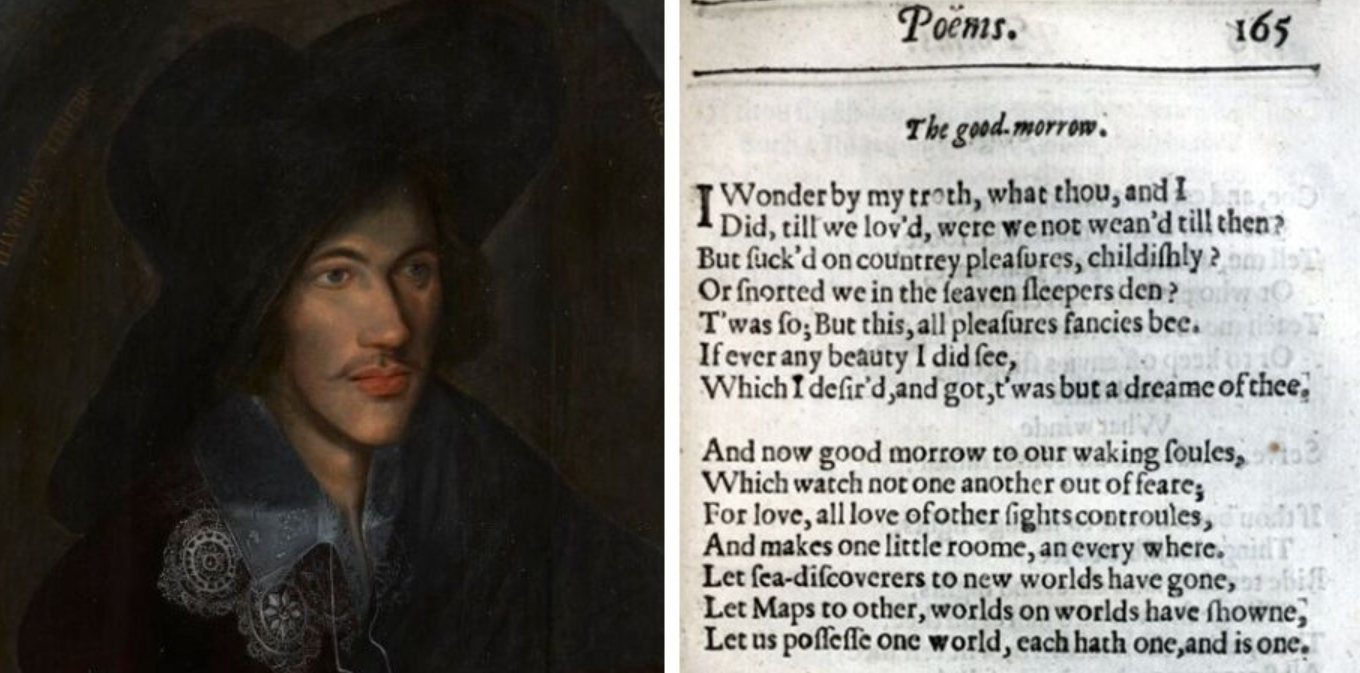
John Donne and George Herbert are easily two of the most significant poets when it comes to Biblical influence in early modern society. The poems “Show me deare Christ, thy spouse, so bright and clear” (14) by John Donne and “Redemption” (15-16) by George Herbert can be comfortably described as two of the most biblical influenced poems in early literature.
John Donne was one of the most brilliant, intelligent and revolutionary poets in the late sixteenth century and early seventeenth century. What makes Donne so interesting though is that he was in fact a Roman Catholic. Not only that but he was a Roman Catholic who lived in a Protestant England and abandoned his faith. Regardless of being born only 10 years after Shakespeare, Donne’s poetry was not like ordinary Elizabethan poetry. This gave Donne certain uniqueness and individuality when it came to writing poetry, because it was different. Aside from this, his style of poetry has been categorized by the poet Samuel Johnson as being a ‘Metaphysical’ poetry. This meant that his poetry dealt with the type of questions that can’t really be explained, such as those in relation to science, God, reality and perception and other philosophical matters. The questions concerned with reality and perception are important when it comes to Donne’s poems and sonnets as a vast majority are filled with metaphors, paradoxes and personifications. In the book “The School of Donne” by A. Alvarez, Donne is described as “Not only one of the most supremely intelligent poets in the language, he was also the first Englishman to write a verse in a way that reflected the whole complexity of intelligence”. (12)
Donne’s sonnet “Show me deare Christ, thy spouse, so bright and clear” (14) can be doubtlessly described as one of his most Bible influenced poems but not in the way most holy sonnets would be. Amongst the various conflicting beliefs, this poem deals with the search for the true Church, and what really is the church? How do we recognize it? Those are but some of the biggest underlying questions in the sonnet. Furthermore, Donne uses personification brilliantly in the sonnet as a means to describe the church as a woman or the bride of Christ. “Show me deare Christ, thy spouse, so bright and clear. What, is it she”. (Donne, 1-2) This is one of the first references we see in the poem that has a direct relation to the Bible. Paul also in a way personifies the church as the bride of Christ in the Bible when he talks about the way husbands and wives should relate to one another in christianity, “What is clearest to me is the way Christ treats the church. And this provides a good picture of how each husband is to treat his wife, loving himself in loving her, and how each wife is to honor her husband.” (New International Version Bible, Paul. 5. 29-33) The poet also refers to the conflicts he is having with his own faith in the sonnet. “Which on the other shore, Goes richly painted? or which, rob’d and tore, Laments and mournes in Germany and here?”. (Donne, 2-4) The poet is basically implying that the Roman Catholics are the “other shore”, “richly painted” and the protestants who are the “Laments and mournes in Germany and here”. Donne is essentially weighing out the differences between the two religions here, and it is clear that despite his paradoxical views on the two, he is still slightly more lenient to the Roman Catholics as he describes them as the “richly painted”. You could also argue that it is in fact a comparison between the Protestant church and the Catholic church, and that the Catholic church is the beautifully painted one and the Protestant one is the one who is full of “Laments and mournes”. This begins to demonstrate the impact the Bible had on Donne’s poetry as this is only four lines into the poem and there is already a vast amount of allusions.
The sonnet is filled with all sorts of vivid imagery, allusions to the romance genre, sexual language and a play on words in order to question the identity and accessibility of the church. We see more of the way Donne uses allusions from lines eight to fourteen, as well as yet another reference to the Bible. “On one, on seven, or on no hill appeare?” (8). Here Donne refers to the Bible when Matthew speaks of how “A town built on a hill cannot be hidden”, (New International Version Bible, Matthew. 5.14-16). The city of Rome is built on seven hills, therefore this is an allusion of the Roman Catholic church. Additionally, towards the final lines of this poem we can see how it’s slowly changed. From lines nine to twelve, Donne makes a brief allusion to a secular romance genre concerning how the “adventuring knights” seek out favours of women to are hard to get because they are either married or are of a higher ranking. This seems irrelevant to the poem at first, but when a close analysis is made it is clear that this is essentially a reference to the difficulty of finding and gaining access to the church. The development of the poem and why those lines are relevant becomes clear in line fourteen, when Donne says, “When she’ is embrac’d and open to most men” (14). This shows how the poem progressed the state of the church, she’ no longer secluded, and the word “open” in that line could possibly make a connection with “clear” line 1. Observing the poem as a whole it can be very easily misinterpreted due to the alludes and paradoxes, but the influence that the Bible had on this sonnet is undeniable.
Putting the conflicting and intelligent mind of John Donne aside, we have George Herbert, who despite having a lot in common with Donne, has a much more graceful, self-conscious and artless feel to his writing. His simplicity and plainness are something in his writing we must also praise. Like John Donne he too was what is known as a “Metaphysical Poet”, always trying to theorize those inexplicable questions in philosophy. Henry Vaughan once called him “a most glorious saint and seer” (Vaughan, Henry. Mount of Olives. 1652). Herbert’s poems are filled with clever imagery and soothing language. Herbert also used a vast amount of parables in his poetry, parables are short narratives that highlight spiritual principles using details from everyday life. His main goal in using these parables was to portray a first-person method in order to capture the reader’s attention and leave them wondering and questioning these principles. In the book “The School of Donne” by A. Alvarez, Herbert was described as having been “a sincere and sensitive poet, and an accomplished artist elaborating his argumentative strain or little allegories and conceits with felicitous completeness and managing his variously patterned stanzas . . .with a finished and delicate harmony” (67).
It is indisputable that George Herbert’s poetry is brimming with biblical influences. Herbert’s poem “Redemption” (15-16) is a very good illustration of how accurate that statement is. This particular sonnet deals with the idea of God as a landlord and a discontent tenant who is seeking out the landlord in order to cancel an old lease and to bargain for a new one. “Having been tenant long to a rich lord, Not thriving, I resolved to be bold, And make a suit unto him, to afford, A new small-rented lease, and cancel th’old”. (Herbert, 1-4) This could be interpreted in many ways; perhaps what the tenant is really speaking of is his own life, that is he is unhappy with the one he has been given and he would like God to give him a new one. This illustrated the influence God may have had on Herbert, that he feels God could have the power to to make a new lease. It is said, however, that this is in fact an underlying contrast of the old and new testament, which shows even further biblical influence in the sonnet. Hebert also used a great deal of alludes just as Donne did. We first see these allusions in lines 12-13 when Herbert says, “At length I heard a ragged noise and mirth, Of theeves and murderers; there I him espied”. (Herbert, 12-13) Here the poet is referring to Matthew 11:19.“ The Son of Man came eating and drinking, and they say, ‘Look at him! A glutton and a drunkard, a friend of tax collectors and sinners!” (New International Version Bible, Matthew. 11. 19). We could argue that perhaps the poet was comparing this story of the tenant and the landlord to that passage of the bible. It is possible the tenant may think that what others think of him, “the son of a man” could mean the son of God, which in this case is the tenant. The final and fourteenth line of the sonnet illustrates that God or the landlord has granted the tenant his wish. “Who’s straight, Your suit is granted, said, and died.” (Herbert, 14). This yet again another allusion of the Bible. “For it is by grace you have been saved, through faith—and this is not from yourselves, it is the gift of God” (New International Version Bible, Paul. 2. 8-9). This highlights the fact that despite what the tenant thought of himself, he has been saved and it is a gift from God for keeping his faith and grace. It is important to note the last two words of the sonnet are “he died”, which further proves the theory that perhaps the lease was a metaphor of the tenant’s life and God granted him his wish, therefore he now dies, in order to start his new life. Furthermore, this exposes even more the biblical influence in the sonnet, despite whether the poet believed the Bible to be true or not, the character he becomes in the sonnet did believe, which shows just how much the story of God can influence someone’s writing.
In conclusion, the influence the Bible had on these two astonishing early seventeenth century poets is unquestionable. Both Donne and Herbert dedicated their writings to philosophical questions that to this day still have no answer, and the Bible entails a vast majority of these questions. The religious prints of these poets went on to influence a number of future poets such as Hopkins, as well as leaving past and present readers wanting more of their conflicting and intelligent words.
Bibliography:
- Donne, John. “Show me deare Christ, thy spouse, so bright and clear”. ENG2128: Novelty, Conflict, Scandal: Course Reader. Galway: PrintThat, 2016. 14. Print.
- Herbert, George. “Redemption”. ENG2128: Novelty, Conflict, Scandal: Course Reader. Galway: PrintThat, 2016. 15-16. Print.
- Alvarez, A. “The School of Donne. Chatto and Windus. 1970
- The Bible. New International Version. Hodder and Stoughton Ltd. 2007