
Robots are no longer just in the movies. Artificial intelligence has become an integral part of our daily lives. From customer service chat bots, to predicting illnesses and generating art, AI systems are blurring the line between human and machine. They analyse data faster than we ever could and we are left to wonder, are we entering a future led by robots rather than people?
As the years go by, more and more countries are integrating Artificial Intelligence into society and Ireland is no exception. No matter where we turn, we now use AI daily whether knowingly or unknowingly. But what is AI? And how does it affect Ireland and its population?
Ireland has always been a tech savvy country. Due to its vast rural landscape, Irish people welcomed the introduction of the internet in the late 1980s to early 1990s and were quick to integrate it into their daily lives, as it made communication far easier. Today, Irish people use internet constantly as part of their day-to-day routine.
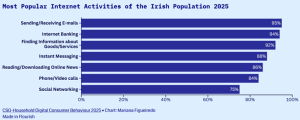
The CSO report on Household Digital Consumer Behaviour 2025 analysed the many different online activities of Irish people 16 and over in their latest survey. The ‘Internet Activities’ section highlights some of the many activities, with sending and receiving e-mails being the most popular at 95%, but internet banking, such a Revolut and Apple Pay, coming in at a close second with 94%, which is up 7% from 2024.
So, we can see how digital Irish people are, but where does AI fit into all of this? It is hard to say when humans first started to use AI tools, as some say it goes back as far as even the 1960s. The iPhone’s Siri was one of the first to become popular, but it was limited, it could only perform basic tasks and follow commands like set reminders and alarms. When you go on holidays and the bank temporary blocks your card for suspected fraud, as it doesn’t recognise that you have left the country, that is an AI system in the background trained to pick up unusual patterns. The customer service chat bots that we talk, to which these are also AI. So, AI has always been there whether we realised it or not.
It wasn’t until the introduction of Generative AI tools such as ChatGPT that AI became a huge part of our lives. Chat GPT was introduced in 2022 and since then it has been a worldwide success. It was the first AI tool which had a human feel to it. It’s free and publicly available to all and it’s the first of its kind to be able to hold thoughtful conversations, solve problems and generate ideas. GenAI tools are designed to generate human-like content be it text or images, and while ChatGPT remains the most known form of GenAI others such as Copilot and Gemini are also being widely used.
The CSO report we looked at includes a section where it also measured the GenAI use amongst Irish people. They found that overall, 42% had used some form of GenAI. It is no surprise that the highest usage was between people aged 16-29 years old with 65%, but 30–44-year-olds also have a significantly high number with 54%.
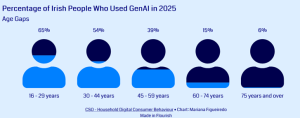
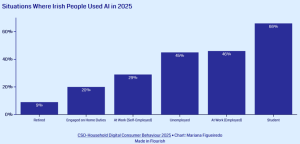
In report it was found that of these 16–29-year-olds the usage was highest among males with 72%, and females were a little lower with 59%. But where are Irish people using AI? The report answers this as well, showing us that it’s most commonly used amongst Students, with 66% having used during the survey’s time period . This is closely followed by people at work with 46% and unemployed people with 45%.
The CSO report shows just how heavily Irish people are beginning to rely on GenAI, particularly younger age groups. But Ireland is not the only country. Across Europe, similar patterns are emerging, with many countries reporting growing numbers of people using AI at home, in school and at work.
Eurostat have published recent figures on AI use throughout Europe. This report on the ‘Use of Generative AI Tools’ reveals that in 2025, 32.7% of people aged 16-74 have used GenAI in the EU. The countries with the highest reported usage were Denmark with 48.4%, Estonia with 46.6% and Malta with 46.5%. Ireland was not too far behind, as it ranked the 5th highest country with 44.9% having used GenAI tools. It is worth mentioning that although not part of the EU, but part of the EEA, (European Economic Area), Norway had the highest usage of all with 56.3% and Switzerland was also quite high with 47%.
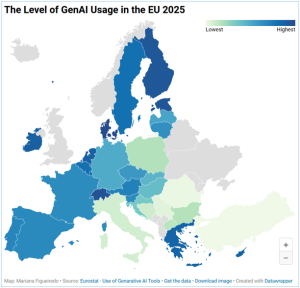
The rise of AI usage doesn’t stop at personal use. Another recent Eurostat report shows that Irish Businesses are adopting AI tools, with a dramatic increase over the last 3 years.
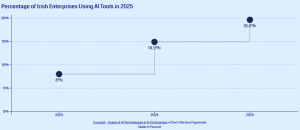
Ireland is considered an important European tech leader in the EU, so it is no surprise that the rise in AI use has increased significantly. In fact, all EU countries showed an increase since 2023. Some of the countries with the highest level of AI usage in enterprises were Denmark once again with 27.6% but also Sweden with 25.1% and Belgium with 24.7%. This illustrates that while Ireland is not at the top just yet, the numbers are rising quickly and could further increase over the next few years.
But what are businesses using AI for? The news article released by Eurostat on ‘Usage of AI Technologies Increasing in EU Enterprises’ reveals that the most commonly used AI tools were ones that would analyse written language and tools that generate language, with some also using speech recognition technologies. This shows that businesses are using AI to help them understand large amounts of text and automate communication related tasks. An example of this is chatbots. Chatbots read what the customer types, understands the meaning and then writes a reply. This saves companies time and money.
The rising numbers indicate how fast the use of AI is spreading, but what effect is this having on people? GenAI brings more convenience, but it also brings risks.
Many are now asking how GenAI is affecting our creativity, our culture and even the ability to think for ourselves. Research from the University of Oxford warns that GenAI poses significant harm to human creativity, not because AI is more creative or better than people, but because businesses may choose to use AI tools over real workers as it is more cost effective.
Source: Google Images
Other writers have also raised their concerns and worry that too much GenAI use could make our minds lazy and weaken our creativity. The convenience of using AI may cause us to slowly lose the ability to think and create our own ideas, as we are not training ourselves to think critically.
This theory is discussed in an article by The Harvard Gazelle, in the ‘Only Humans Can Solve Human Problems’ section, where Senior Lecturer Fawwaz Habbal discusses that:
“While AI excels in data processing and statistics, it lacks the ability to create truly innovative and creative solutions.”
He goes on to add that:
“AI can engage in processes that resemble critical thinking […] but it has limitations. Critical thinking requires the human experience, the human insight, and ethics and moral reasoning.”
What these works are trying to emphasise is that AI does not actually create, it generates and copies what already exists, at least for now. The issue is the culture surrounding AI. People use it as a way to avoid putting effort into thinking.
This concern has even appeared in pop culture. In 2023, the series South Park released an episode called ‘Deep Learning’, where students were secretly using ChatGPT to write text messages and responses to their girlfriends, instead of thinking of what to say for themselves. The episode used comedy to show that this is a real fear.
Another growing concern about GenAI is what some people are calling ‘AI Slop’. This refers to low-quality AI generated content that has taken over the internet. An RTE article written about AI Slop warns that the spread of this AI generated content could make it harder to trust what we see online. This is happening especially with older people as it becomes harder to tell the difference between what is real and what is not.
With AI already having such a significant impact on how we think and write, we wonder what comes next. We watched movies like ‘I, Robot’ and thought about how unrealistic it was, but this idea is now starting to seem less ridiculous and more of a real possibility. Elon Musk has already introduced this idea to the world with the development of the robots ‘Optimus’ which were created with the intention of working in homes and businesses.
With the introduction of ‘Agentic AI’, experts believe we could see AI systems acting more independently. A Guardian article talks about how experts like Adam Dorr believe that these future systems combined with robots may one day replace many human jobs.
But where is Ireland in all of this? Ireland is already planning ahead for this future. The Government’s ‘Updated National Digital Strategy’ indicates that their aim is to make Ireland a strong digital leader, encouraging the country for an AI-driven future. It aims to support the safe use of new technologies, encourage digital skills and help workers and businesses adapt to changes in jobs. The strategy emphasises the importance of using AI in a safe way, without harming creativity or employment.
So, the robots aren’t taking over just yet. AI is growing fast in Ireland and across the EU, and it is already changing how we think, work and create. But for now, robots are still our tools and not our rulers. As long as we continue to be aware and properly educated on AI, we can remain in charge, and hopefully, it stays that way.

Source: Google Images