
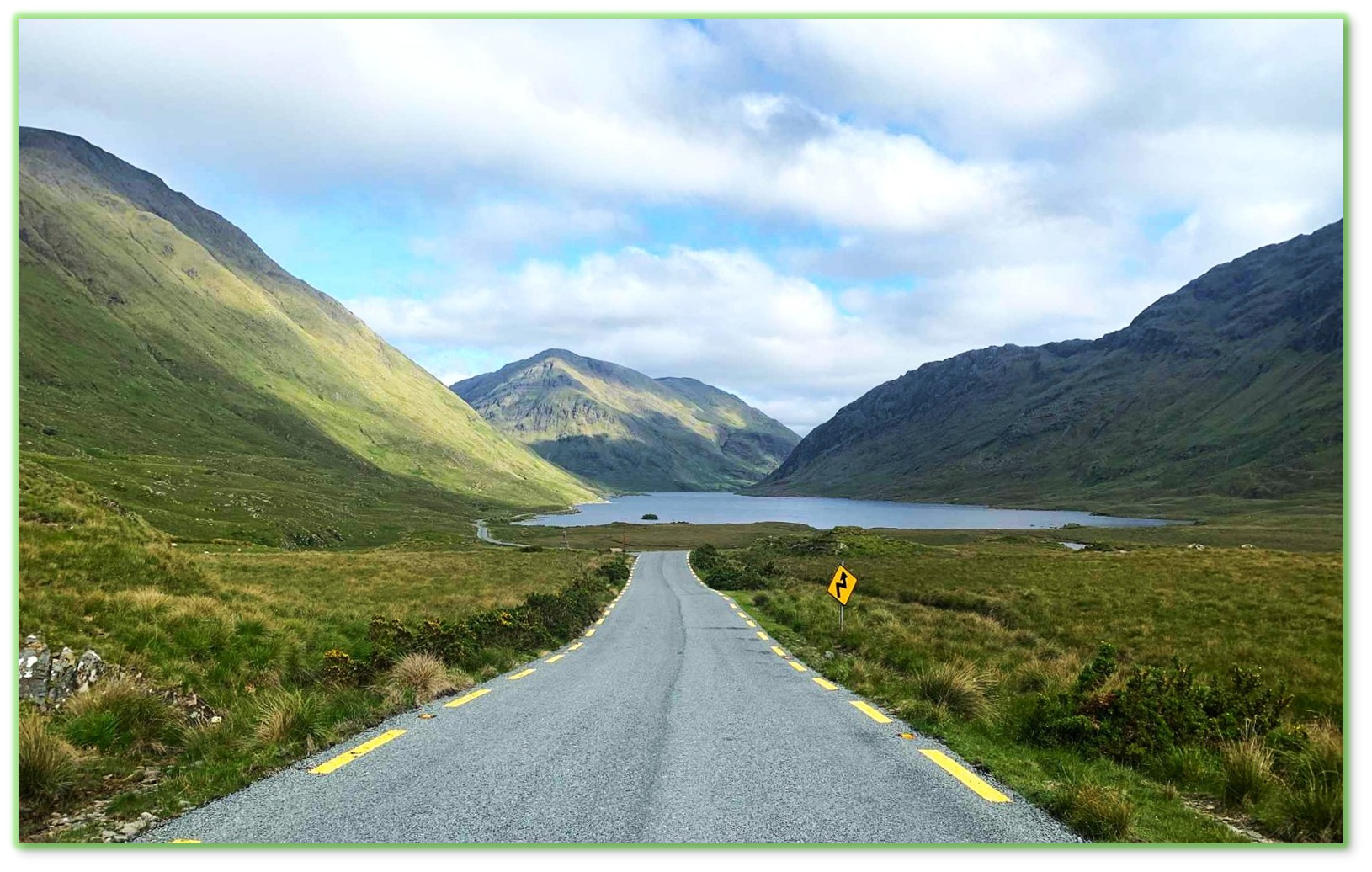
There is much to be explored in Ireland. From medieval castles to sheep-filled green fields, the rich culture, the friendly nature of the people and the stunning landscape; these are just some of the reasons why many choose to visit the country.
Whilst Irish people tend to leave the country in the summer months in pursuit of hotter weather, many choose Ireland as their destination for holidays. Tourism is a vital part of Ireland’s economy and understanding who visits and why is essential for its growth.
According to a report from the Central Statistics Office, (CSO), on Inbound Tourism September 2025, August is the most popular month for foreign visitors in Ireland based on data from the last three years.
So how many tourists visit Ireland in the month of August? Based on the CSO’s Inbound Tourism reports for August 2023, 2024 and 2025, the numbers haven’t increased significantly. 2023 showed that Ireland had 737,600 foreign visitors, this increased slightly in 2024 to 763,600, and 2025 saw a further small increase to 772,800.
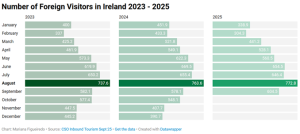
Although the increase is small, the high volume of tourists that visit in August is hugely important to Ireland’s tourism industry. August attracts more visitors than any other month by a large margin, meaning that visitors are likely attracted to Ireland during its brightest and longest days of the year. According to reports from Met Éireann, August 2025 was the fourth warmest August on record.
 Dog’s Bay Beach, Connemara, Co. Galway, Aug 25. Source: Mariana Figueiredo
But where do Ireland’s visitors come from ? The CSO data on Inbound Tourism reports mentioned above, shows a clear pattern across 2023, 2024 and 2025. The data reveals the majority of Ireland’s visitors only come from a few key countries. The largest number of visitors came from the UK, with 32.5% in 2023, 35.7% in 2024 and 36.2% in 2025. Following this, we have visitors from the USA with 19.3% in 2023, 18.8% in 2024 and an increase in 2025 of 23%. Other significant countries to mention, with lower but consistent numbers are Germany, France, Spain, Portugal and Italy.
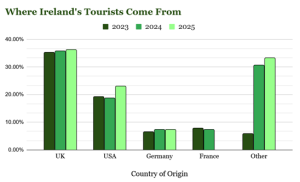 Chart: Mariana Figueiredo – Source: CSO Inbound Tourism Reports 2023, 2024 & 2025 – Created with Google Sheets
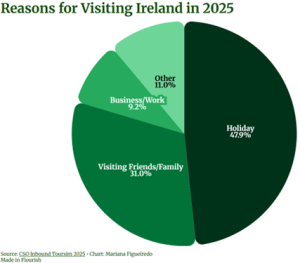
The same CSO data also shows that most tourists visit Ireland for leisure more than any other reason. In August of 2025, 47.9% of Ireland’s foreign visitors came for a holiday. A further 31% came to visit family or friends, 9.2% came for Business or work-related trips and the remaining 11.9% were for events, education and other unknown reasons. The figures for 2023 and 2024 are similar to what was recorded in 2025, demonstrating that Ireland continues to be primarily a holiday destination for many.
Link to interactive visualisation.
Whilst the CSO’s Inbound Tourism reports show us that there is a slight increase in the number of people visiting Ireland, the report highlights that the number of nights the visitors are spending in the country has actually decreased. Ireland saw an 8.7% decrease in the total nights stayed between August 2023 and August 2025.
This reflects what while Ireland is seeing more visitors, they are making shorter trips. The reasons for this are likely to be due to the cost of flights, hotels and overall goods. Whilst the CSO does not provide detailed information on hotel rates or flight prices in relation to tourism, their Consumer Price Index for August 2025 indicates that there was an increase of 2.6% in Hotel and Restaurant prices when compared to the previous year.
This has led to an increase in visitor spending in Ireland. The CSO Inbound Tourism reports from 2023, 2024 and 2025 state that visitor spending has increased from €737 million in 2023 to €818 million in 2024. In 2025 the total spent was €744 million which is a drop from the previous year but still an increase from 2023. According to a report from Fáilte Ireland, ‘Tourism Barometer September 2025’, 54% of hotels reported their revenue had increased from the previous summer.
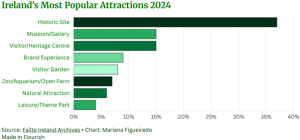
So, where are tourists visiting? According to Fáilte Ireland’s archives from 2024, Historic Sites are the most visited attractions, 37%, followed by Visitor/Heritage Centres and Museums, 15% each.
 Link to interactive visualisation.
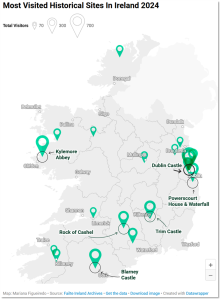
Ireland is known for its vast number of Castles. Many of the Historic Sites mentioned above are popular castles around Ireland. According to the Fáilte Ireland report from 2024, the top 5 most visited castles were: Dublin Castle with a total of 727,189 visitors, followed by St. Patrick Cathedral in Dublin City with 600,000 visitors, Kylemore Abbey in Connemara with 572,673, Blarney Castle with 490,000 and lastly Powerscourt House, Garden’s and Waterfall with 467,216.



Powerscourt Waterfall. Powerscourt House & Gardens. Source: Mariana Figueiredo
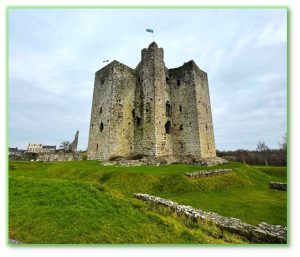
Trim Castle. Source Mariana Figueiredo


Kylemore Abbey. Source Mariana Figueiredo
The photos above show some of Ireland’s most famous and beautiful castles. But whilst Ireland may be a popular holiday destination for some, it is still not the most travelled country to in Europe.
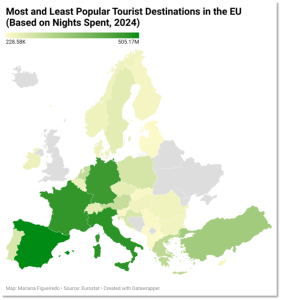
According to Eurostat’s ‘Nights spent at tourist accommodation establishments 2024’ report, Ireland is quite low in the tourism market within the wider European context. Spain the country where most choose to spend their holidays with over 505 million tourists having spent nights there last year. Following this is Italy with over 466 million, France with over 457 million and Germany with over 439 million. These 4 countries alone account for the majority of the tourism activity in the EU. Ireland’s total number of tourism nights is significantly lower, 41.6 million, putting it at a medium range of tourism intensity alongside countries like Belgium and Denmark.
 Link to visualisation.
The map above shows that while Ireland is a popular destination in its own right, its overall tourist scale is quite small when compared with other EU countries.
Tourism trends are important to analyse to highlight the implications that it has on Ireland’s economy and society. The CSO data demonstrates that while visitor numbers are increasing slowly, the decrease in the number of nights spent shows that tourists are becoming more cautious with time and money, which may have a significant impact on Ireland’s hospitality sectors. Compared to the EU, Ireland is on the smaller side of the scale, highlighting the need for a strategic plan to continue steady growth.